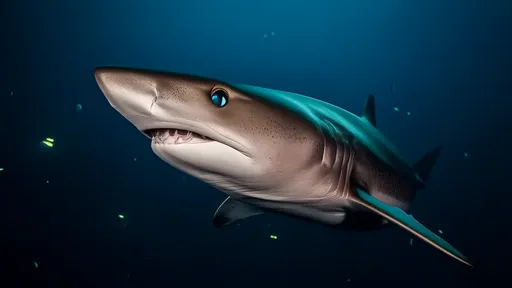
In the perpetual darkness of the deep ocean, where pressure crushes all but the most resilient creatures, the Greenland shark (Somniosus microcephalus) glides through the icy waters with an almost eerie lethargy. This enigmatic species, often called the "sleeper shark" for its sluggish movements, has fascinated biologists for decades. But what truly sets it apart isn’t just its slow pace—it’s the shark’s astonishingly low metabolic rate, a trait that allows it to survive in one of Earth’s most inhospitable environments while outliving nearly every other vertebrate.
The Greenland shark’s metabolism is so sluggish that scientists once speculated it might be the slowest of any fish. Its movements are deliberate, its growth achingly gradual. Researchers estimate that these sharks grow less than a centimeter per year, reaching sexual maturity only after a century or more. This glacial pace of life is a direct adaptation to the cold, nutrient-scarce depths it calls home. Unlike the frenetic predators of sunlit waters, the Greenland shark doesn’t chase prey. Instead, it ambles through the abyss, relying on scavenged carcasses and the occasional unlucky squid. Its slow burn of energy means it can go months—possibly even years—without a meal.
The secret to this shark’s longevity lies in its cold-blooded efficiency. With a body temperature nearly matching the surrounding water (as low as -1°C in the Arctic), its cells operate at a fraction of the speed seen in warmer, faster-moving species. This isn’t just a quirk of biology; it’s a masterclass in energy conservation. Every heartbeat, every muscle contraction is optimized for minimal expenditure. Even its muscle tissue contains high levels of urea and trimethylamine oxide (TMAO), compounds that prevent proteins from destabilizing under crushing pressures—and may contribute to its famously foul-smelling flesh, which is toxic if eaten untreated.
But the Greenland shark’s slow metabolism comes with trade-offs. Its lethargy makes it vulnerable to parasites like the copepod Ommatokoita elongata, which latches onto its eyes, rendering the shark nearly blind. Yet, in a twist of evolutionary irony, this blindness might not matter much. In the lightless depths, the shark likely relies more on smell and electroreception to locate food. Its sluggishness also means it’s no match for faster predators, but in the deep sea, where energy is scarce, speed is a luxury few can afford. The shark’s strategy is simple: outlast everything. With lifespans exceeding 400 years—the longest of any known vertebrate—it’s a strategy that works.
Recent studies have uncovered even more surprises about this deep-sea relic. Analysis of its genome reveals mutations in genes linked to metabolic regulation, suggesting a evolutionary path fine-tuned for extreme energy efficiency. Unlike most sharks, which rely on constant movement to breathe, the Greenland shark can likely pump water over its gills while stationary, another adaptation to its low-energy lifestyle. Even its reproductive cycle is slow, with gestation periods possibly lasting over a decade. For scientists, these findings raise tantalizing questions about how metabolism shapes lifespan—and whether the shark’s biology could hold clues for human aging.
The Greenland shark’s existence challenges our assumptions about what it means to be a predator. In a world where speed and aggression often dominate, this ancient shark thrives by doing less. Its story is a reminder that survival isn’t always about being the fastest or the strongest—sometimes, it’s about being the most patient. As climate change alters ocean temperatures and ecosystems, researchers worry how this slow-motion marvel will adapt. For a creature that has endured for centuries, the greatest threat may now be a world changing too quickly for its timeless strategy.

By /Jun 11, 2025

By /Jun 11, 2025
By /Jun 11, 2025
By /Jun 11, 2025
By /Jun 11, 2025
By /Jun 11, 2025
By /Jun 11, 2025
By /Jun 11, 2025
By /Jun 11, 2025
By /Jun 11, 2025
By /Jun 11, 2025
By /Jun 11, 2025
By /Jun 11, 2025
By /Jun 11, 2025
By /Jun 11, 2025
By /Jun 11, 2025
By /Jun 11, 2025