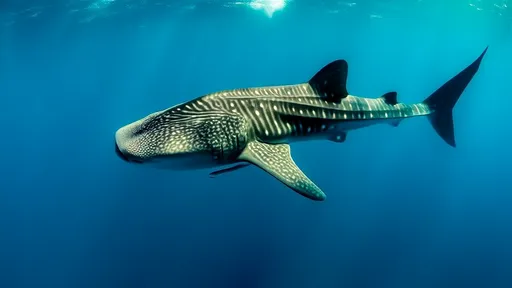
The ocean holds many mysteries, but few creatures capture the imagination quite like the whale shark. As the largest fish in the sea, this gentle giant glides through tropical waters with an almost otherworldly grace. Unlike its more predatory cousins, the whale shark is a filter feeder, sustaining itself on some of the smallest organisms in the marine ecosystem. Its sheer size—often exceeding 40 feet in length—combined with its docile nature makes it a favorite among divers and marine biologists alike.
Whale sharks are often mistaken for whales due to their massive size and feeding habits, but they are, in fact, sharks. Their scientific name, Rhincodon typus, places them in a distinct family of carpet sharks. What sets them apart from other sharks is their feeding mechanism. Instead of sharp teeth designed for tearing flesh, whale sharks possess thousands of tiny teeth and rely on specialized filter pads to strain plankton, small fish, and even microscopic organisms from the water. This adaptation allows them to thrive in nutrient-rich waters where other large predators might struggle.
One of the most fascinating aspects of whale sharks is their migratory behavior. These creatures are known to travel vast distances, often following seasonal blooms of plankton or spawning events of fish and coral. Researchers have tracked individual whale sharks crossing entire ocean basins, revealing just how interconnected marine ecosystems truly are. Despite their global distribution, they are most commonly spotted in warm waters near the equator, including the coasts of Mexico, the Philippines, and Western Australia.
Despite their imposing size, whale sharks are remarkably gentle and pose no threat to humans. In fact, many ecotourism operations have sprung up around the world, offering snorkelers and divers the chance to swim alongside these majestic animals. Locations like Ningaloo Reef in Australia and Isla Mujeres in Mexico have become hotspots for responsible whale shark encounters. Strict guidelines are often in place to ensure minimal disturbance to the sharks, emphasizing the importance of conservation even in tourism settings.
Unfortunately, whale sharks face significant threats from human activities. Overfishing, bycatch, and boat strikes are persistent dangers, while habitat degradation and climate change further jeopardize their populations. The species is currently listed as endangered by the International Union for Conservation of Nature (IUCN), prompting increased efforts to protect them. Marine protected areas, fishing regulations, and international cooperation are all critical components of conservation strategies aimed at preserving these oceanic giants for future generations.
Scientists continue to uncover new details about whale shark biology and behavior. Recent studies have explored their longevity, with some individuals estimated to live over 100 years. Their slow growth rate and late maturity make them particularly vulnerable to population declines, highlighting the need for long-term conservation measures. Advances in tagging technology and genetic research are also shedding light on their breeding habits, though much about their reproduction remains a mystery.
The cultural significance of whale sharks cannot be overlooked. In many coastal communities, they are revered as symbols of good fortune and ecological balance. In the Philippines, for instance, local fishermen once believed that harming a whale shark would bring bad luck, a tradition that has helped foster a sense of stewardship. Today, education and community engagement play vital roles in conservation efforts, ensuring that these ancient mariners continue to inspire awe and respect.
As our understanding of whale sharks deepens, so too does our responsibility to protect them. They are not just icons of the ocean’s grandeur but also key players in maintaining the health of marine ecosystems. By supporting sustainable practices, advocating for stronger protections, and fostering a deeper connection to the natural world, we can help ensure that these gentle giants endure for centuries to come.

By /Jun 11, 2025
By /Jun 11, 2025
By /Jun 11, 2025
By /Jun 11, 2025
By /Jun 11, 2025
By /Jun 11, 2025
By /Jun 11, 2025
By /Jun 11, 2025
By /Jun 11, 2025
By /Jun 11, 2025
By /Jun 11, 2025
By /Jun 11, 2025
By /Jun 11, 2025
By /Jun 11, 2025
By /Jun 11, 2025
By /Jun 11, 2025
By /Jun 11, 2025