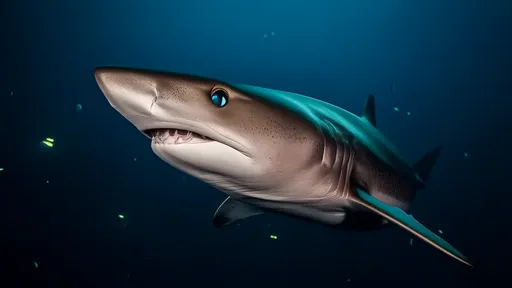
In the icy depths of the Arctic Ocean, a mysterious giant glides silently through the freezing waters. The Greenland shark, a creature that has captured the imagination of scientists and adventurers alike, is not just any ordinary predator. It holds a secret that defies the very laws of life and death—an astonishing lifespan that can stretch beyond 400 years, making it the longest-living vertebrate known to science.
The Greenland shark, or Somniosus microcephalus, is a true marvel of evolution. Found in the frigid waters of the North Atlantic and Arctic Oceans, this elusive shark has adapted to one of the harshest environments on Earth. Its sluggish movements and ghostly appearance—often scarred by parasites—mask an incredible resilience. Unlike most sharks, which rely on speed and agility to hunt, the Greenland shark takes a different approach. It moves with an almost lethargic grace, conserving energy in waters where food is scarce and temperatures hover just above freezing.
What truly sets this shark apart, however, is its mind-boggling longevity. In 2016, a groundbreaking study revealed that Greenland sharks could live for centuries, with one individual estimated to be at least 392 years old. Some scientists speculate that the oldest of these sharks might even surpass 500 years. This discovery turned heads in the scientific community, as no other vertebrate had ever been found to live so long. The secret to their longevity lies in their incredibly slow metabolism, a trait that allows them to grow at a glacial pace—sometimes less than a centimeter per year.
The life of a Greenland shark is a study in patience. They reach sexual maturity at around 150 years old, an age when most other creatures have long since passed away. Their slow reproductive rate means that populations are particularly vulnerable to threats like overfishing and climate change. Despite their size—they can grow up to 7 meters in length—they are rarely seen by humans. Most of what we know about them comes from accidental catches or deep-sea research expeditions.
But how do these ancient predators survive for so long? Scientists believe their cold environment plays a crucial role. The near-freezing waters slow down their biological processes, reducing cellular damage over time. Additionally, their tissues contain high levels of compounds that may protect against age-related decay. Unlike humans, whose cells deteriorate with time, Greenland sharks seem to possess a biological "fountain of youth" that allows them to endure for centuries.
Yet, their longevity comes with its own set of challenges. The sharks are often blind, their eyes clouded by parasitic crustaceans that latch onto their corneas. Remarkably, this doesn’t seem to hinder them much. They rely heavily on their other senses, particularly smell, to navigate the dark depths and locate prey. Their diet is as varied as it is unusual—they’ve been known to eat fish, seals, and even polar bears, though much of their feeding habits remain shrouded in mystery.
For indigenous Arctic communities, the Greenland shark has long held cultural significance. The Inuit have traditionally hunted these sharks for their liver oil, which was used as lamp fuel and medicine. However, the shark’s flesh is toxic when fresh due to high concentrations of trimethylamine oxide, a chemical that helps them survive the extreme pressures of the deep. Only through a lengthy fermentation process can the meat be rendered safe to eat, resulting in a pungent delicacy known as "hákarl" in Iceland.
Today, the Greenland shark faces an uncertain future. Climate change is rapidly altering its Arctic habitat, with rising temperatures and melting ice disrupting the delicate balance of the ecosystem. Commercial fishing also poses a threat, as these sharks are often caught as bycatch in nets meant for other species. Conservation efforts are complicated by the shark’s slow reproductive rate and the vast, remote areas it inhabits.
Despite these challenges, the Greenland shark continues to fascinate researchers. Each new discovery about its biology offers clues not just about the shark itself, but about the broader mysteries of aging and survival in extreme conditions. Could studying these ancient creatures unlock secrets to extending human life? While that remains speculative, one thing is certain: the Greenland shark is a living testament to the wonders of evolution, a creature that has silently witnessed centuries of history in the planet’s most unforgiving waters.
As we delve deeper into the secrets of the Arctic, the Greenland shark stands as a reminder of how much we still have to learn about the natural world. Its story is one of endurance, adaptation, and the incredible passage of time—a story that continues to unfold with each passing year, just as slowly and surely as the shark itself moves through the icy depths.

By /Jun 11, 2025

By /Jun 11, 2025
By /Jun 11, 2025
By /Jun 11, 2025
By /Jun 11, 2025
By /Jun 11, 2025
By /Jun 11, 2025
By /Jun 11, 2025
By /Jun 11, 2025
By /Jun 11, 2025
By /Jun 11, 2025
By /Jun 11, 2025
By /Jun 11, 2025
By /Jun 11, 2025
By /Jun 11, 2025
By /Jun 11, 2025
By /Jun 11, 2025