The electric off-road paradox presents one of the most intriguing engineering challenges of our time: how to reconcile the seemingly contradictory demands of deep water fording and high-voltage electrical systems. As automakers push the boundaries of electric vehicle (EV) capability, the traditional weaknesses of internal combustion engines in water are being replaced by new concerns about battery packs, motor controllers, and high-voltage wiring harnesses.
Water has always been the great equalizer in off-road environments, capable of stalling even the most powerful diesel engines when intake systems succumb to hydrostatic lock. Electric propulsion systems theoretically eliminate this vulnerability since they don't require atmospheric oxygen for combustion. Yet the reality proves more complex, as engineers must now protect sensitive electronics from conductive water intrusion while maintaining the thermal management crucial for battery performance.
The fundamental tension arises from competing design priorities. Off-road vehicles demand generous ground clearance and sealed components when fording rivers, while electric architectures benefit from low-slung battery placement for stability. This creates what industry insiders call "the wading compromise" - the delicate balance between keeping water out and maintaining optimal weight distribution.
Modern solutions employ multi-layered defense strategies. Battery enclosures now feature military-grade IP67 or IP69K ratings as standard, with some manufacturers experimenting with pressurized housings that maintain positive internal air pressure to actively repel water intrusion. Motor units are being redesigned with hydrophobic coatings on stator windings and redundant sealing systems that activate when submerged.
Thermal management presents perhaps the greatest paradox. While water immersion might seem like an ideal cooling mechanism, the reality is that most battery systems cannot tolerate sudden temperature differentials. Engineers are developing adaptive systems that can switch between liquid cooling loops and air cooling depending on external conditions, with some prototypes using phase-change materials that absorb heat during water crossings.
The electrical architecture itself is undergoing quiet revolution. Traditional 400V systems are giving way to 800V architectures not just for faster charging, but because higher voltage allows lower current for the same power output - reducing risks of electrolysis in submerged connections. Some manufacturers are even exploring dielectric fluids that can safely surround live components during temporary immersion.
Real-world testing has revealed unexpected failure points. While major components prove resilient, ancillary systems like parking brakes and suspension air compressors often become weak links. The industry response has been comprehensive redesigns of these supporting systems, with some models now featuring electromagnetic parking brakes and fully mechanical suspension adjustments for extreme conditions.
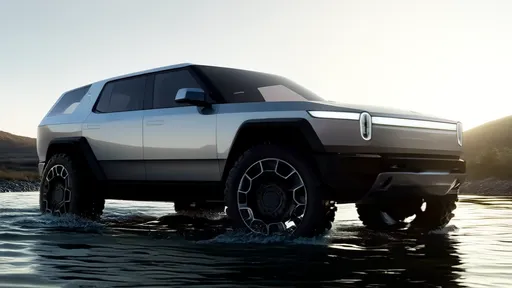
Consumer expectations are driving much of this innovation. The off-road community, traditionally skeptical of electrification, now demands EVs that can match or exceed conventional vehicles' water fording capabilities. This has led to remarkable demonstrations, with several electric SUVs successfully completing crossings that would drown traditional vehicles, albeit with carefully managed protocols.
The regulatory landscape adds another layer of complexity. Unlike combustion engines which simply need to avoid ingesting water, electric systems must prevent any conductive path between high-voltage components and occupants during and after immersion. This has spawned new testing standards that evaluate not just immediate function after water exposure, but continued safety during the drying-out period.
Material science breakthroughs are quietly enabling this revolution. New generations of potting compounds can withstand thermal cycling while maintaining perfect seals, and conductive ceramics are replacing traditional metals in some high-voltage applications. Perhaps most promising are self-healing insulating materials that can automatically repair minor breaches in waterproofing barriers.
The psychological barrier may prove harder to overcome than the technical ones. Decades of internal combustion experience have ingrained certain instincts about water crossings - the sound of an engine's pitch change as the exhaust dips underwater, the visual cue of a snorkel's safe height. Electric vehicles provide fewer such sensory confirmations, requiring drivers to trust in invisible protective systems.
As the technology matures, we're seeing the emergence of specialized off-road modes in electric vehicles that go beyond mere torque vectoring. These systems proactively prepare the vehicle for water immersion by pressurizing critical systems, pre-cooling batteries to create thermal headroom, and even temporarily isolating non-essential circuits to minimize potential failure points.
The ultimate test comes not in controlled demonstrations, but in real-world expeditions where vehicles face prolonged exposure to muddy, debris-filled water. Early adopters report surprising reliability, with some electric off-roaders proving more resilient than their diesel counterparts in sustained tropical conditions, thanks to the absence of air filters to clog or mechanical components to corrode.
Looking ahead, the next frontier involves not just surviving water crossings, but leveraging electric propulsion's unique capabilities during them. Engineers are experimenting with controlled short-circuiting techniques that could theoretically use surrounding water as an emergency heat sink, and buoyancy management systems that could adjust vehicle attitude in deep water. The electric off-road paradox, once seen as an insurmountable contradiction, is gradually being solved through relentless innovation that may ultimately redefine what's possible in extreme terrain.
By /Jun 14, 2025

By /Jun 14, 2025
By /Jun 14, 2025
By /Jun 14, 2025
By /Jun 14, 2025
By /Jun 14, 2025
By /Jun 14, 2025
By /Jun 14, 2025
By /Jun 14, 2025
By /Jun 14, 2025
By /Jun 14, 2025
By /Jun 14, 2025
By /Jun 14, 2025
By /Jun 14, 2025
By /Jun 14, 2025
By /Jun 14, 2025
By /Jun 14, 2025